
Patrick Nunes
Global Communications and Design at Rotary

These days, everyone is an AI expert. Here’s why that’s a good thing: People coming to you asking about whether you’re using AI or suggesting what you should do with it are opening doors to conversations that would, back before the GenAI wave hit us, likely be closed or very difficult for localization and globalization teams to pry open. At least, that’s how we choose to view these situations at Rotary — remember this deliberate stance; it’s something I’ll get back to in a moment.
Whether they happen to you or you initiate them, these conversations are opportunities for you to build bridges with your stakeholders to find common ground and solutions. You typically engage in them for the greater good, i.e., the company’s best interests, but a lot of personal growth and leadership skills can be found and developed when going through the alignment exercise. In a time when a lot of business discussions are focused on what you can do with tech, it’s the thousand-year-old practice of sitting down and having a conversation that will be the most impactful in moving the needle. In other words, it is a very human thing to do.
Proactive beats reactive, any day, every day
One of the first conversations I had once GenAI appeared on the radar was with a colleague from HR who asked, “Have you seen this, and how do you think this will matter from a human perspective?” You’ve undoubtedly heard a variant of the same question being asked. I continue to have similar conversations at least once a week. This is part of our new normal. Everyone has opinions about AI, and especially about how others should be using it. In this case, I was consulted for my opinion, but your experience may vary if the person doesn’t know you are the in-house expert on all things language AI. Sometimes, you may be on the receiving end of a very prescriptive “Here’s what you should be doing…” type of opening statement.
I typically get ahead of the conversation by showing the person asking the question that I thought about this and showing them how we are tackling it. Better yet, invite them to be part of the solution you’ve been working on for the specific problem. In other words, doing your homework is key to aligning with your stakeholders. It has two components: Naturally, you want to educate yourself about everything on a given topic. You needn’t do this alone; you can rely on your team and others inside the organization to surface the necessary knowledge. Secondly, you want to put yourself in the shoes of the person coming to you with the question — they are doing their due diligence, and it should be safe to assume that they’re coming into the conversation with good intentions. Tune in to what they are saying and how they are saying it.
It starts with you, the humans in the loop
To pretend GenAI doesn’t impact our day-to-day life would be naive. The key to understanding its impact — and approaching conversations with peers, stakeholders, or vendors the right way — is examining what AI means in my daily work, for my team members, or the organization. In a way, you’re painting a pre-mortem tableau: What will using AI (or not) mean X months from now? If you’re not looking inward and expanding your horizon first, you won’t be fast enough when the external prompt arrives. We’re in a window of opportunity where AI gives us a platform to be more visible and multiplies the conversations we’re having. We — the localization and globalization experts — have a role to play in these conversations.
Being human-centric is the only way to bring new ideas — or new technology, in this case — into the fold. You can’t be tech-forward without being human-centric because so much of your success relies on partnering with humans.
Often, I respond to questions with a “Have you spoken with Mary or Joe about this?” You must remain humble enough to acknowledge that your role will differ at different times. Sometimes, you’re the driver in the conversation, helping to frame it (especially when it comes to language AI), but sometimes, you will be the passenger who loops in other experts in the company. This is a beautiful thing for alignment purposes:
- You show you know what you’re talking about because you know who can add value to the conversation, so you loop them in. Equally important, you’re not wasting the time of the person asking the question.
- You elevate the colleague and their expertise by bringing them into the conversation. You’re expanding the scope of the conversation by bringing in others who can help the collective to advance.
You won’t always arrive at this type of win-win-win scenario. But you absolutely should be developing your ability to identify opportunities to broaden the conversation. It starts with the homework you should do during downtime when no one asks questions.
Now, you may not always arrive at an entirely satisfactory conclusion when working with a stakeholder. Sometimes, invisible roadblocks will prevent you from advancing, no matter how much goodwill you or your counterpart puts into the effort. When this occurs, it’s an invitation for you to pause and ask yourself — is this a space you want to be in? If you’re uncomfortable with the situation or the culture in the company, what can you do to change it? There’s always a win in it for you if you ask this, even if seemingly no one has won.
The three fundamentals of alignment
So many of the exchanges you will have are situational and context-dependent. But the attitude you take into them matters and can significantly alter the conversation’s outcome. If we wanted to summarize the fundamentals of alignment, I believe the following three precepts will help you go a long way in any situation:
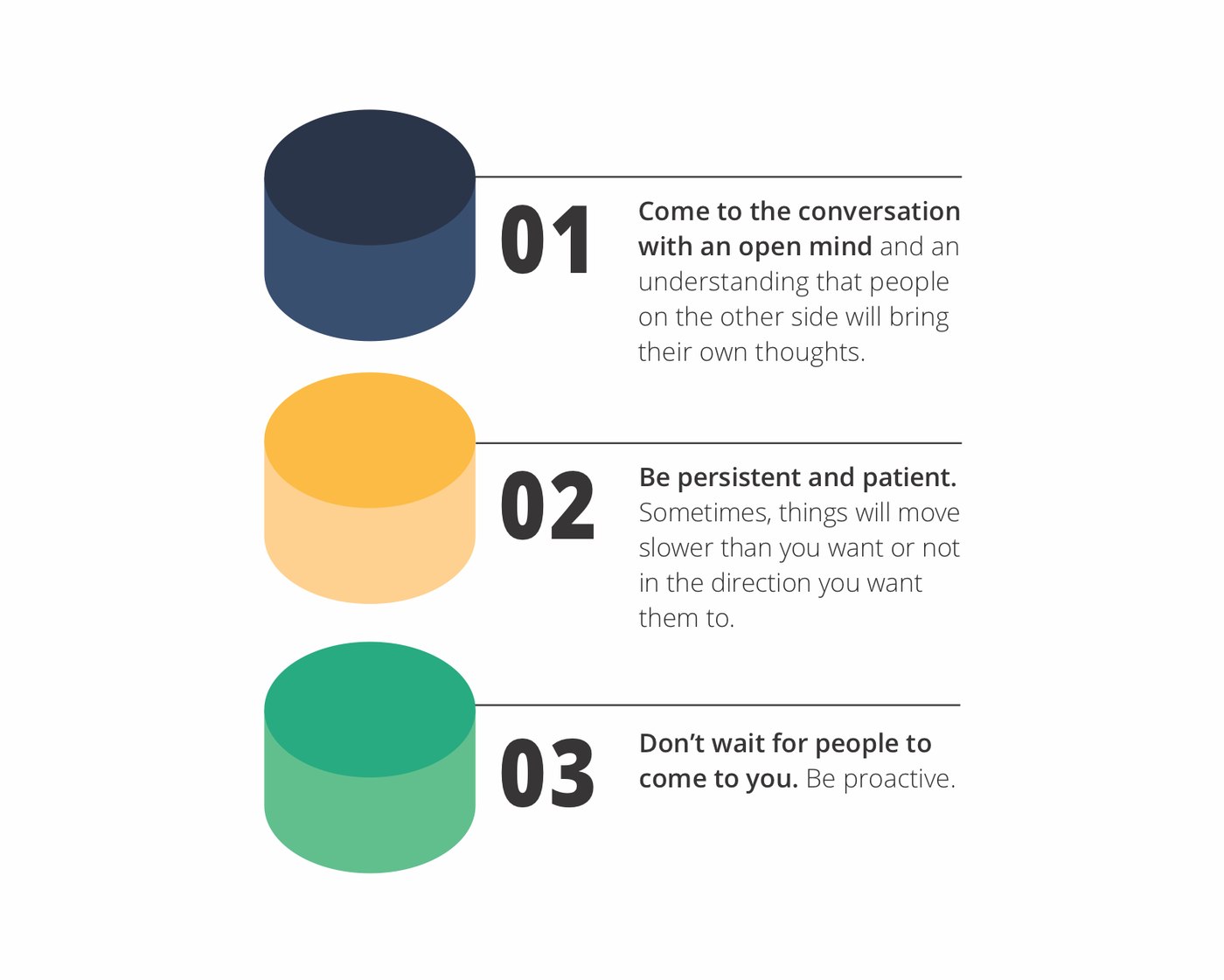
- Come to the conversation with an open mind and an understanding that people on the other side will bring their own thoughts, knowledge, and biases. They’re just doing their work, and the following is true — they don’t know what you know (and vice versa). Your understanding and knowledge of the topic vary, especially now that AI is such a prominent feature of our workdays, and you will find both sides are using different words to express the same thing. Bring the person you’re talking to along, broaden their horizons, and help them help you. That’s where alignment magically clicks into place.
- Be persistent and patient. Sometimes, things will move slower than you want or not in the direction you want them to. Sometimes, it becomes personal and that’s where human-centrism becomes essential. It is important to be persistent and patient and have a plan B (or plan C, D, or E, although hopefully they won’t be needed).
- Don’t wait for people to come to you. Be proactive. Too often in the localization space, we suffer from the complex of being last in line or forgotten. Learn to package your value and show your counterpart where you’re coming from. You may also need different types of packages depending on who you’re talking to.
What is waiting for you once you read this article? More conversations and some you may have been putting off. Alignment has been a strategic priority for localization and globalization leaders for ages. It’s nothing new — and certainly not exclusive to our industry. The crystal ball is a tempting lens to try and look through and an important function of leadership. A few years ago, the crystal ball question looked at a horizon of 4-5 years; today, it’s 4-6 months. When working with people, you have an opportunity to make them see the trajectory and the journey we’re all on. Some things may take time, but we’re also working on accelerated timeframes, where things evolve fast. Seek out the conversations you avoided. Those are the ones that move the needle.





-
Meanwhile, in Marketing Land
Marketing adopted AI early and fast. What its experience with hyper-personalization, plagiarism risk, and consumer distrust signals for localization.
-
Resetting the Status Quo: Will We Need a TMS 10 Years From Now?
If large language models can process files directly, what remains of the translation management system a decade from now?
-
Transformation Is Not Going out of Fashion
Rebuilding a localization team across two continents while keeping delivery running, and why transformation challenges outlast every technology cycle.