

Miguel Sepulveda
Globalization Director at King

One aspect that often goes unnoticed when a company decides to localize its products is that it has, deliberately or unwittingly, committed to inclusivity and accessibility. And once you commit, there is no space for half-measures. So, how about broadening the focus and making localization, globalization, inclusivity, and accessibility all part of the mission statement? Others are already doing it.
If you pause to think about it, localization and globalization are crucial elements of a broader global focus on accessibility and inclusion. This may be more evident to those in the language industry, but it’s a message we must continue spreading far and wide. Accessibility is all about removing barriers. Sometimes, these barriers are physical, and other times, they are virtual. Both dimensions of accessibility are valid and widely accepted, yet the role of localization in helping to remove barriers is often overlooked. A barrier is anything that prevents you from achieving something or moving forward. Imagine you’re reading a menu in a Korean street food restaurant. Is there anything more obstructive to having a good experience — and a full belly at the end — than not understanding what you read?
Not understanding a language is a barrier to use, a barrier that prevents you from enjoying a good user experience, and also a barrier to inclusivity. When a company decides not to adapt its products to other markets, it is inadvertently making an exclusionary decision. It creates two user groups and makes the ones who don’t speak the language feel like second-rate citizens. Therefore, localization and globalization are key parts of a broader strategy that goes beyond merely translating languages or adapting products to different markets; it encompasses ensuring that products are usable and beneficial for everyone, regardless of their language, culture, and cognitive or physical abilities.
As we look to the future, the importance of creating inclusive and accessible experiences will grow. Companies prioritizing these aspects will meet evolving ethical and legal standards, benefit from increased user engagement, and be better positioned to expand their market reach. Really, what’s not to like in taking the inclusive route?
Future prospects
As technology helps us create more interconnected systems, it is reasonable to expect the demand for accessible and inclusive products will only increase. Accessibility and inclusion will become standard practices rather than exceptions. Designing technologies and products with diverse user needs in mind from the outset will be crucial. Companies that fail to do so may lag in user adoption and market expansion. It is essential to create a sense of urgency about incorporating principles of inclusion and accessibility into our globalization strategy.
Learning from early adopters
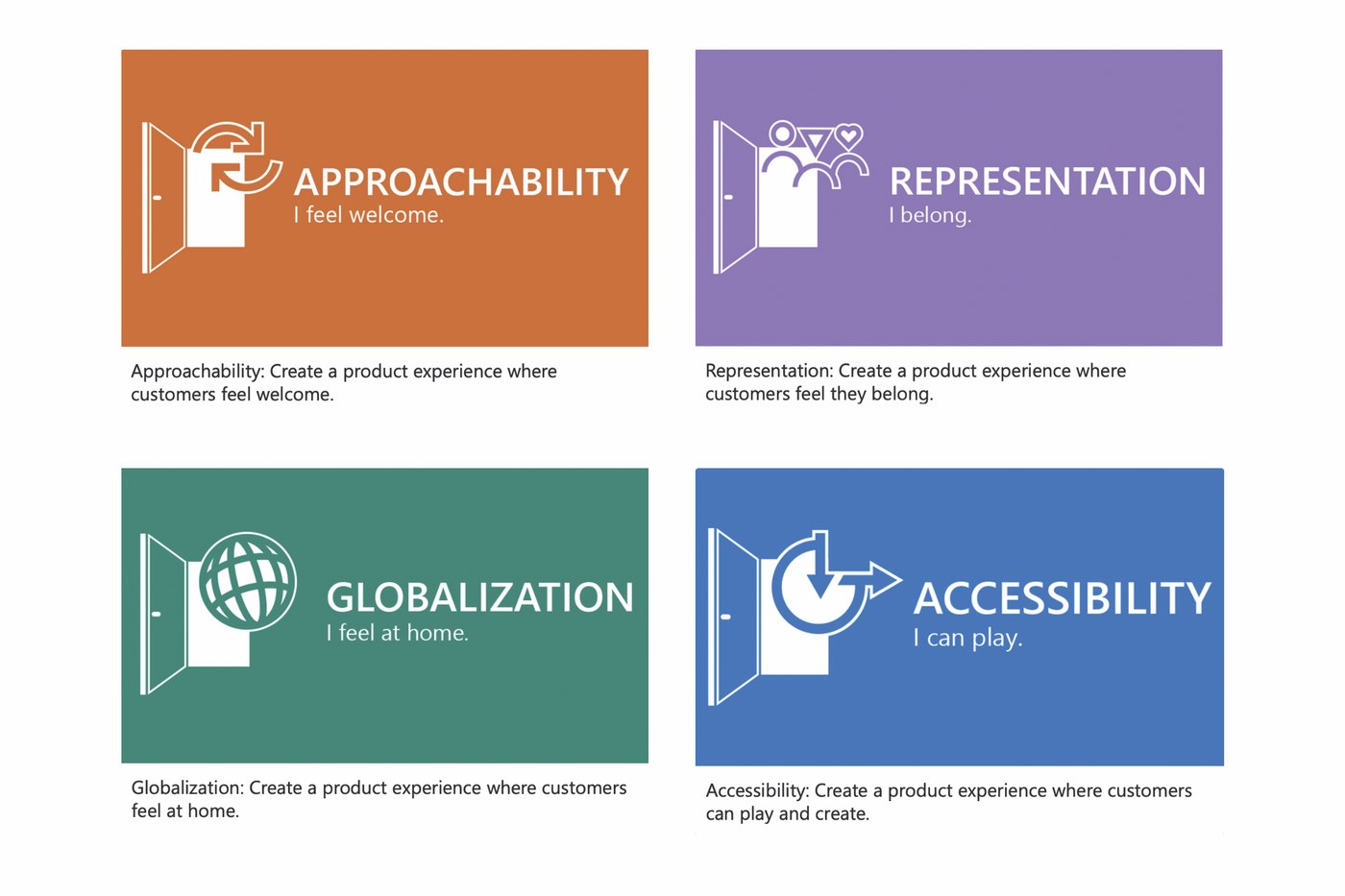
There are valuable lessons to be learned from those who have integrated accessibility and inclusion into their company strategy. Look no further than Microsoft, which has developed the Product Inclusion Framework to help developers create more inclusive products for its professional software and gaming divisions. Katy Jo Wright, Head of Gaming for Everyone & Sustainability at Microsoft, unveiled this framework in a well-received presentation during the Games Development Conference (GDC) in March 2024 in San Francisco, presenting a model designed to revolutionize how developers approach creating digital products.
The presented model introduced four pillars — approachability, representation, globalization, and accessibility — that give developers the tools to make inclusive products that meet the needs of some three billion gamers globally. These pillars, or doorways as Microsoft defines them, open the door to a world where barriers fade away (Microsoft Product Inclusion Framework). As you can see, globalization is a core part of this initiative. But Microsoft is showing us that our industry and work are part of something bigger and more wholesome — and that they matter.
Results and impact
The impact of ignoring accessibility is clear and goes beyond entertainment products such as the aforementioned video games. According to Forbes, in 2021, retailers risked losing as much as USD 828 million in sales over Christmas due to inaccessible websites. And that number has likely grown in recent years.
Legal issues can also threaten companies that do not consider accessibility as part of their strategy, as seen in the Supreme Court’s decision against Domino’s in a disability rights case (Slate). Thinking about accessibility and inclusion when designing products is not only the right thing to do, but also a moral obligation that we must gradually embrace since, according to the World Health Organization, 1.3 billion people worldwide experience significant disabilities.
However, despite our work being “the right thing to do” and contributing to something bigger, measuring the impact of the localization program’s actions is as important as ever. Companies that fail to understand how their localization efforts contribute to their objectives will struggle to embed these efforts into their mission and vision. As management guru Peter Drucker said, “What gets measured gets managed.” The truth is that the localization industry has struggled for years to consistently measure the impact of globalization programs. It doesn’t necessarily get easier if you shift your focus to include accessibility and inclusion.
Initial returns from focusing on accessibility and inclusion are promising, with companies reporting increased user satisfaction, higher engagement rates, and expanded market reach when investing in inclusive practices. Still, learning to quantify this impact with metrics is vital. Let’s once more turn to Microsoft for guidance on how to measure the impact of our actions.
Measuring the Progress Towards Product Inclusion
Source: Microsoft Product Inclusion Framework
| Category | Metric | Description |
|---|---|---|
| Approachability | New User Retention Rate | Measures how many new users continue to use the product after initial adoption, indicating the product’s initial appeal and usability for novices. |
| Approachability | Engagement | Measures the quality and quantity of time spent by users on the platform, indicating their ability to approach and engage with the ecosystem. |
| Approachability | Customer Service Satisfaction | Surveys or metrics from customer service interactions gauge if users feel supported, reflecting the quality and approachability of customer support. |
| Approachability | Trust and Safety Incident Reports | Quantifies incidents that breach trust or safety, aiming for a reduction, reflecting how safety and trust are built into the system. |
| Representation Metrics | Demographic User Data | Breakdown of the product user base by demographic factors, essential for understanding if the product resonates with a diverse audience. |
| Representation Metrics | Community Engagement | Participation rates of underrepresented communities in forums, beta tests, or co-creation initiatives. Active engagement suggests that co-creation efforts are effective, leading to a sense of belonging among participants. |
| Representation Metrics | Sentiment Analysis by Demographics | Analysis of user sentiment segmented by different demographic groups, helping identify if certain groups have less positive experiences. |
| Representation Metrics | Inclusive Content Ratio | The proportion of content featuring or catering to underrepresented groups, measuring the extent of representation in the product’s content. |
| Globalization Metrics | Market Penetration | Measures engagement with users in each region, indicating global reach and acceptance. |
| Globalization Metrics | Localization Quality | Measures the effectiveness of localized content through user feedback and error rate reporting, reflecting the quality of localization efforts. |
| Globalization Metrics | Growth Markets | Measures the rate of growth in monthly active users (MAU) or monthly active devices (MAD) in a region compared to the growth rate in the healthiest markets, indicating growth proportions and market health. |
| Globalization Metrics | Cultural Relevance Score | User ratings on how culturally relevant they find the product, assessing whether the product feels at home in various cultures. |
| Globalization Metrics | Global Customer Feedback Loop Efficiency | The time it takes for global customer feedback to be acknowledged and acted upon, indicating responsiveness to global user needs. |
| Globalization Metrics | Regional/Market Views on Metrics | Analyzing other metrics (such as New User Retention and Engagement) with a regional or market view to reveal disparities in the user experience. |
| Accessibility Metrics | Usage of Accessibility Features | Metrics on how often accessibility features are used by whom, showing how many users benefit from accessible design. |
| Accessibility Metrics | Usability of Accessibility Features | Measures the usability of an accessibility feature or capability, showing user feedback on accessibility features. |
| Accessibility Metrics | User Ability Success Rate | Success rates of users with disabilities completing core tasks, indicating how well the product supports users with various abilities. |
| Accessibility Metrics | Compliance with Legal Accessibility Standards | The degree to which the product meets legal accessibility standards, serving as a baseline measure of accessibility compliance. |
| Accessibility Metrics | Support and Help Desk Tickets | The number of support tickets related to accessibility, indicating areas where users face challenges with accessibility features. |
Blueprint for the future
Successfully embedding inclusion in product development will require deliberate action. This involves focusing on approachability, representation, and globalization. Companies should seek feedback from diverse user groups, partner with local creators and communities, and engage community members throughout the product development process. It’s also crucial to customize experiences with easy-to-use personalization options and design products that remove language and cultural barriers.
There is no one-size-fits-all approach, as each region and market requires tailored approaches. This is nothing new for language industry professionals. Yet this also puts localizers in an excellent position to help product teams create inclusive and accessible user experiences for diverse global users.
It may be difficult to pinpoint the precise moment we started it, but we are already on the journey toward a more accessible and inclusive future (digital or physical). By integrating localization and globalization efforts with accessibility and inclusion best practices, companies can create products that are not only widely accessible but also deeply meaningful, improving lives and leaving lasting memories. This approach will lead to a more equitable product landscape where everyone can benefit from technological advancements regardless of background or abilities. Embracing these practices today is shaping up as one of the important pathways we must take to continue meeting the challenges and opportunities of tomorrow.



-
Humans at the Core
Human expertise remains the deciding factor in language quality as AI takes on more of the production workload across the content lifecycle.
-
Setting up Language Technology for Inclusive and Non-Binary Language
Inclusive and non-binary language poses concrete technical challenges for translation memories, machine translation, and terminology management.
-
Quality in Translation: Back to Service
Automation has made service a rare commodity in translation. Why client relationships, not throughput, increasingly define quality.