Scaling a global product across 21 languages requires more than adding translators as demand grows. At ŌURA, a wellness device company, the globalization team — deliberately kept at three people — has approached international growth by building durable operational infrastructure rather than expanding headcount.
“Customers don’t experience products on screen at a time. They experience the entire journey. So if any parts of this chain are not properly done, then it’s very visual, and it’s really obvious that you’re not ready for an international launch.“
The core shift has been moving from informal, knowledge-in-people’s-heads processes typical of startups to documented, repeatable workflows that support a maturing global organization. This transition became urgent when the team added 10 new languages in under six months while the broader company was also scaling rapidly. Each new language introduces distinct technical and compliance considerations — right-to-left layout support, region-specific wellness regulations, and varying testing requirements — meaning that language-portfolio growth compounds complexity rather than simply adding volume.
Artificial intelligence adds a further layer of nuance. AI-generated features must be localized without sacrificing terminology consistency, and because AI outputs vary between runs, quality assurance requires a more measured, testing-heavy approach than traditional localization. Rather than treating AI adoption as an end in itself, the team evaluates where it improves quality assurance, content workflows, and decision-making, while preserving human review where it remains necessary.
“Customers don’t experience products on screen at a time. They experience the entire journey. So if any parts of this chain are not properly done, then it’s very visual, and it’s really obvious that you’re not ready for an international launch.“
Looking ahead, the team’s roadmap is not focused on adding more languages or markets. Instead, the priority is consolidating existing gains: simplifying processes, increasing automation, expanding QA testing capability, and reducing manual work. The underlying premise is that stronger foundations create room to innovate proactively rather than simply reacting to growth pressure.
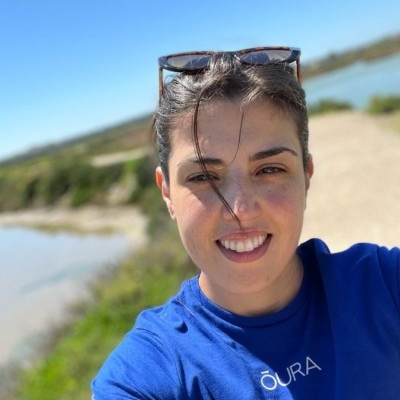
Cristina Núñez
Senior Manager of Globalization at ŌURA
Below is an automated transcript of this episode
Stephanie Harris-Yee: [00:00:00] Hello, welcome to another episode of Global Ambitions. I’m your host, Stephanie Harris-Yee, and today we’re joined by Cristina Núñez, who’s Senior Manager of Globalization at ŌURA.
Cristina, welcome
Cristina: Thank you. Thanks so much
Stephanie Harris-Yee: So can you tell us in maybe just two or three sentences a little bit about yourself?
Cristina: Yes. So my name is Cristina, as you said, I lead ŌURA’s globalization team. We make sure our products and customer experiences can scale successfully across international markets. So my team basically enables global launches by bringing together localization testing, language quality, and cross-functional collaboration in 21 languages now.
Stephanie Harris-Yee: Oh, wow. Nice. So there’s been a lot of pressure recently on localization teams such as your own adapting the best use of AI, C-suite pressures, all of this. Most of it is all centered around this idea of growth. Growth for the [00:01:00] growth for the team, et cetera. So today I wanted to get a little bit into what you and your team are doing. So with this push for growth becoming even stronger these days how have you and your team been adjusting?
Cristina: I think here at ŌURA, the biggest shift has been moving from processes that work well at a smaller scale to processes that can support a much larger global organization. So we went from semi-startup or startup to a probably more mature company. I would say when companies grow quickly it’s easy for knowledge to live in people’s heads and don’t have documentation.
Teams solve problems as they appear, and decisions can happen very informally. Everybody relies on experience rather than structure. And that works for a while, but eventually you reach a point where it [00:02:00] no longer scales. Now supporting twenty-one languages across a very, very broad ecosystem not just the app, but customer support, emails, and so on we need much more.
So at that scale, consistency becomes just as important as speed. A large part of our work has been building stronger foundations, improving documentation creating clearer workflows, defining repeatable processes strengthening handoffs between teams and making planning much more predictable.
Stephanie Harris-Yee: Right
Cristina: But also and I want to add here we also have to take a look at ourselves and recognize that our internal team is intentionally small. There are only three of us internally. So scaling has never been about simply hiring more people. It has been, being very specific on what we want to do, focusing on building strong partnerships with [00:03:00] linguists, language service providers, and everyone.
This is one, one end. And then we’ve spent a significant time amount of time improving systems around how we work, so CAT tools, testing environments, plans, processes, and all this. So the, the goal ultimately for us is not just simply localizing every time more and more content, but building a localization function that can continue support growth without, quality becoming a bottleneck in this regard.
Stephanie Harris-Yee: So it sounds like you’re doing a lot with a very small team. What’s been one of the biggest challenges that you’ve come up to so far, and how are you working around it?
Cristina: So this last year, probably the biggest challenge has been pace because we introduced 10 new languages in less than six months while the organization itself was growing rapidly. [00:04:00] So at the same time, we have to add our documentation processes, tooling. We’re still very startup and we’re maturing.
So, that creates a very different challenge from simply managing more translation work.
Stephanie Harris-Yee: Right
Cristina: So as the language portfolio grows, complexity also grows. Some languages I have to say introduce technical challenges around layouts or right-to-left. For instance, this year was the year of right-to-left.
Others require additional testing, different review approaches, and all that. Because we are a wellness device, so we also have to take into consideration wellness and legislation ensuring that we are compliant. That’s one thing, and then I’m gonna open the box, but AI has added another layer.
So traditional localization, I believe, it’s already challenging, but multilingual AI experiences raise completely [00:05:00] different questions, terminology, consistency, and we have some AI-generated features that we are trying to turn into localized experiences for our users. And the thing with AI is that results are not the same every time.
So they they change. So that’s one of the reasons we take a measured approach. It’s not also simply about making AI available but it’s about making sure the experience actually meets the quality standards. So for me, growth has been or means reducing uncertainty
early as possible. I would say that’s the key factor for me, and this means clearer priorities, stronger communication, better risk management, and testing better continuously improving processes that support delivery.
But this challenge is like having everything and trying to, organize [00:06:00] everything into boxes and make sure that everybody else is understanding what we have in front of us.
Stephanie Harris-Yee: So with that, you mentioned, testing things and trying different ways to do things. Is there anything that you could give people maybe in a similar situation? They haven’t started that testing process. Is there any tests that you’ve done that just didn’t work, or any methods that you didn’t work that you can warn people against?
Or any that have been, like, really successful?
Cristina: So I would say there are certain things that we’ve done, but one of the things that I probably think it’s a good start and it can be used in any scenario is don’t scale chaos. In companies, we have tendencies of “Oh, this needs to be rushed. This needs to be done.”
And yes, of course, we have to be aware of timelines, and we have to be aware of things. But we try not to yeah, scale chaos. If something is incomplete documentation needs [00:07:00] reworking, workflows depend on individual knowledge, or tools are not configured properly those problem become exponentially harder as the organization grows.
That’s something that you have to sit because we live hectic times, and we don’t have time to think, but you have to sit, think, and maybe you need to sit with other people on your company and decide, “Okay, what’s the direction that we want to follow?” So I do believe that’s really important.
And then the other thing is, and this is, this doesn’t normally depend on globalization or localization teams, but involve localization early. I think that’s one of the key points. Localization shouldn’t simply receive work once everything has already been decided. The earlier we are involved, the easier everything becomes to be identified, like technical constraints, market considerations now that I mention legislation.
Medical devices or [00:08:00] semi-medical devices require different definitions or are different, differently compliant depending on the region. So you have to bear this in mind. So localization, even though it’s a boring thing, or you might not like it because it adds a lot of complexity and a, a lot of work to other stakeholders it’s really relevant.
It’s not isolated pieces of content. It’s a program that should be linked and work together with the rest.
I would say that. Because localization when it’s not done properly, It’s very obvious, and customers don’t experience products on screen at a time.
They experience they experience the entire journey. So if any parts of this chain are not properly done, then it’s it’s very visual, and it’s really obvious that you’re not ready for an international launch
Stephanie Harris-Yee: Okay. So you’ve done a lot of the [00:09:00] groundwork now. You’ve been working on setting up these systems, these workflows, making sure all of the ducks are in a row, as they say. So what’s next for your team in say, the next six months? Do you have a continuing plan around that, or are you jumping into something new?
Cristina: Now we are actually, we are getting ready and we are preparing the roadmap for the next fiscal year. So the next phase isn’t about expanding. There are not a lot more languages that at this point of maturity we can add. So it’s not expanding to new languages or markets, but it’s about strengthening what we have already
built.
So mainly the focus would be on making the operating model more mature simplifying processes or making more processes where it’s relevant. Improving automations. That’s very important because we have been doing a lot of manual work, so reducing manual work is [00:10:00] another thing that we would like to do.
And especially, and this is something that we’ve seen also, expanding the testing capabilities because we have tested but not enough. And now that we can add QA automation and QA testing, we will add that to our workflow. This doesn’t mean that we are not using humans. Not at all. I think we are gonna be using humans for when it makes sense, but we should use AI where it makes sense.
I’m very excited specifically about where AI can take us internally.
Because it can help us keep up with growth because it has the potential to improve how localization operates from quality assurance to content creation workflows and decisions. I would say we would need to ensure that the foundations are solid.
I would say the foundations are stronger today than [00:11:00] they were a year ago, which means we have more opportunities to innovate instead of simply, reacting to growth
Stephanie Harris-Yee: Yeah. Oh, that’s awesome. Yeah, that’s something that I’ve definitely noticed in my team as well, just especially if you’re in a small team, AI has really given us the opportunity to have a little bit more breathing space in some areas. So that’s great. Okay. any, any final thoughts?
Anything else you’d like to share?
Cristina: I would say let’s not be scared to both growth and AI. Growth is exciting because it does create opportunities, but it, on the contrary, also exposes every weakness in the systems, the processes, and the way we work together. I, I would say this and about localization, because it has been very much questioned in, in almost all the companies that I’ve worked.
There’s always someone saying, “But is localization necessary? Why [00:12:00] do we localize if our main customer is based in the US?” I would say to those people, this is not just about translating content. Localization, it’s about building operational foundations that allow a company to grow internationally.
The most rewarding part of the job is not just launching another language and adding more languages to our list, but it’s building a system that makes the next launch better than the last. And every time you release something, or every time you add a new language, you learn from the previous experiences, and you are one step closer to maybe not perfection, but you’re one step closer to do things properly, better, and without doing so many iterations, I would say
Stephanie Harris-Yee: Okay. thank you so much, Cristina, and yeah, I really appreciate your insights, and I’m sure the folks listening will as well
Cristina: Thank you, Stephanie. Thanks for everything
Related listening: for another operator’s take on scaling international growth, see Go-to-Market Strategy at Pinterest with Francesca Di Marco.
-
Preparing a Business Case for Localization
Ep #36 – Jan 25, 2021 – What are the considerations you need when writing a business case for localization? Natalia Levitina shares practical advice and steps.
-
Go-to-Market Strategy at Pinterest
Ep #4 – Feb 01, 2021 – Francesca Di Marco, International Ops at Pinterest shares her international go-to-market strategy.
-
Transforming International Go-to-Market
Ep#25 – June 29, 2021 – Anna Schlegel, VP at Procore, shares how she transformed the process of going after international markets at several companies over her career.