

Petr Antropov
CRO and Co-founder of Lokalise

Callout: Access the “How localization enables growth strategies” report.
The current economic situation is apparently so uncertain that some experts, including prominent investors Jeremy Grantham and Scott Minerd, fear we may be in for a stretch as bad as the dotcom bust in 2000 — the year Amazon launched Amazon.fr.
Amazon.fr was the first of Amazon’s three foreign sites to be built from scratch, going to great lengths to go native by hiring “a great team of people to make the site local.” By 2003, Amazon Europe (the UK, Germany, and France) and Amazon Japan represented 35% of total revenues.
As that example suggests, a recession may not be such a bad time to start localization.
Unprecedented challenges facing companies
With the declines in tech and retail stock prices, layoffs, rising inflation, interest rates, and persistent supply chain issues, companies are facing undeniable adversity.
How should companies respond to these economic developments?
A natural impulse is to cut costs across the board:
- Postpone new projects
- Cut marketing expenditure
- Freeze new hiring
- Reduce headcounts
I believe these aren’t necessarily the best strategies for the current times. During a recent conference, I discussed this at length with Reid Christian from CRV and found myself nodding in agreement with his view:
“If you have an opportunity to grow incredibly quickly, customers need your product, you need to continue to build your team to support them, and build out your platform, carry on with the growth.”
Someone who thinks, “I better not focus on offensive moves now, because the economy is so bad,” is making the same mistake as the people who thought during the boom, “all I have to do is grow at all costs,” without thinking about profitability and business fundamentals.
But the payoff for acting in a bad economy is higher than for waiting. Here’s how companies can benefit from localization in this volatile environment:
- Expand while competitors are cutting back. Bad times mean less competition. It’s the right time to gain market share by attracting customers from competitors with a better customer experience as they cut down on customer services.
- Buy assets and companies on sale. From 2008 to 2010, companies like Apple, Google, Microsoft, and Facebook acquired over 150 companies and thousands of new IPs from smaller tech companies that were forced to close due to the recession.
- Acquire top talent in more countries. Talent is global and more available now than during an expansionary phase (especially with the massive layoffs in the tech sector.)
It’s also easy to forget that localization can be a smart defensive tactic. For example, you’re the incumbent anticipating a new entrant in the local market. New localization efforts can help entrench your position as an established brand.
A global meltdown in the economy doesn’t mean these benefits don’t add up. It’s not time to slow down globalization. On the contrary, it’s time to accelerate it. As Intel’s CEO confessed in the great recession of 2008: During downturns, Intel doubles down on R&D, looks for more talent to fill future needs, and accelerates expansion plans.
For most executives, would it not pay to wait until the economy is better before taking the localization leap? Earlier this year at Lokalise, we wondered if waiting for certainty appealed to C-level decision makers, so we commissioned Dimensional Research to find answers.
If we learned one thing from our research, it’s the sheer scale of localization already under way.
We found that 88% of respondents come from companies that either already localize their products or are planning to do so over the next 18 months.
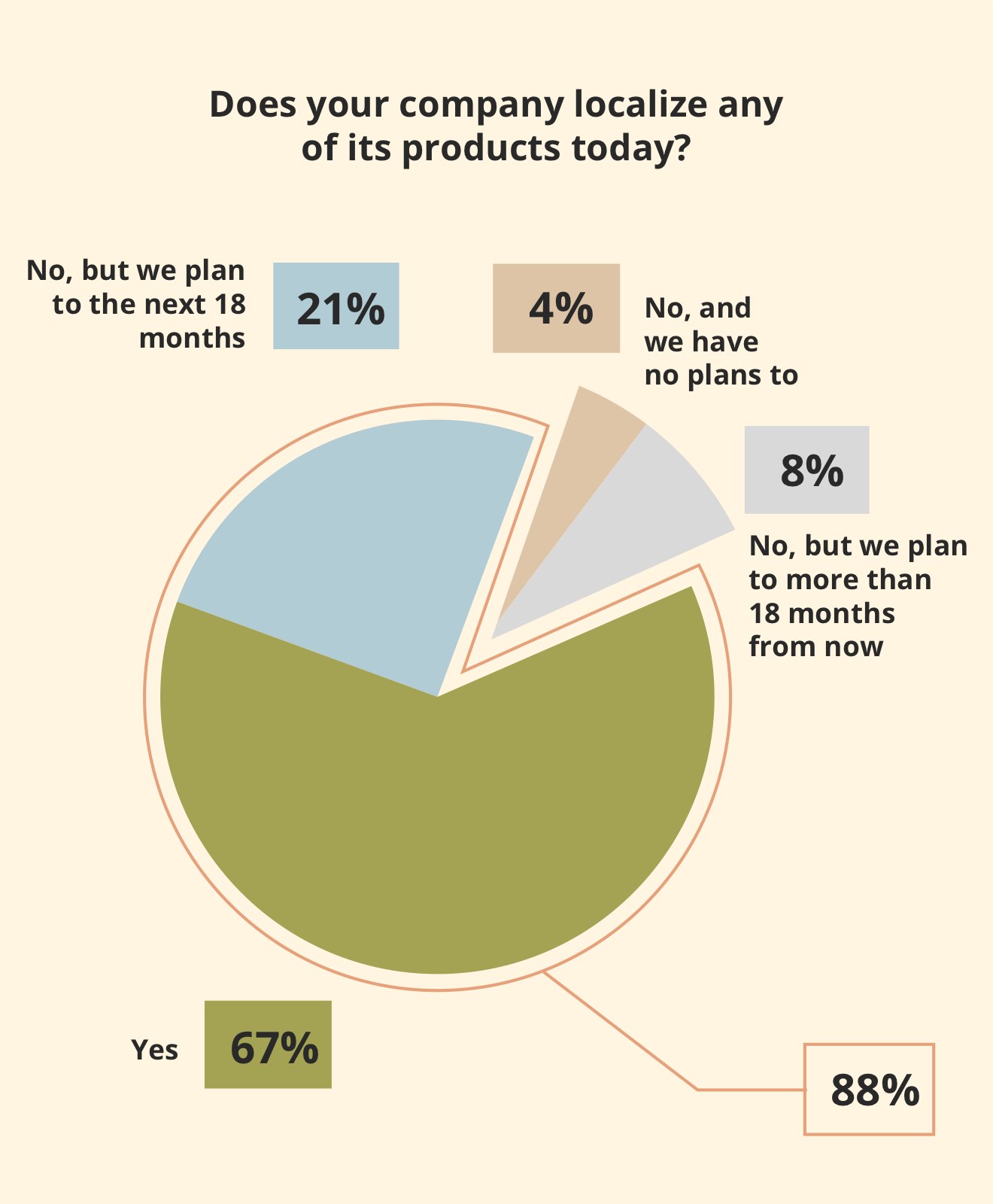
Chart — “Does your company localize any of its products today?”
| Response | Share |
|---|---|
| Yes | 67% |
| No, but we plan to in the next 18 months | 21% |
| No, but we plan to more than 18 months from now | 8% |
| No, and we have no plans to | 4% |
(Yes + planning within 18 months = 88%, as cited in the text. Table reproduced from the source chart image.)
From speaking to many of the companies surveyed, it’s clear that this growth opportunity is only possible with effective executive and C-Suite buy-in. In fact, 51% of our respondents told us that their executive teams make the big decisions about how localization is accomplished.
New focus on sustainable growth
Recall that the dotcom bust was a reversal of many large public companies, many of which were burning investor money with little or no revenues.
As Reid pointed out to me, “If you’re growing 3X but burning a bunch of money at all costs, you should focus more on growing 2X and burning very little money in a more efficient way.”
One of the best strategies for the current times is to serve more people around the world. Localization is a safe and sustainable growth strategy because it enables companies to expand their customer base in a scalable way. The big-picture insight from our research is that 84% of the companies surveyed plan to expand their global footprint by adding new markets this year.
We’ve always felt that localization is an obvious growth strategy and the easiest way to dip your toes in the waters of a new market. It offers a cost-effective, sustainable way to diversify investment in another market without driving a huge amount of personnel, resources, and funding elsewhere. Increasing efficiency also becomes a priority when other growth opportunities disappear during an economic downturn. Localization is a safe bet in addressing both: sustaining growth and increasing efficiency.
How localization enables growth in economic downturns
As Amazon and other companies leading the way in localization have discovered: Successful international expansion hinges on tying growth to the new languages in which they plan to make their products available. [Sentence appears truncated in the source PDF — likely continues around/beneath the adjacent chart in the original layout; not recoverable from text extraction.]





-
Tech Innovations to Keep an Eye on: AI TM Cleanup and AI Backtranslation
AI TM cleanup and AI back translation apply semantic analysis to language assets, cutting review time while improving translation quality.
-
How Pinterest Embraces the Change for its 400 Million+ Users
Pinterest separates a universal global message from locally recreated content, treating inclusion and accessibility as prerequisites, not afterthoughts.
-
How Product-Led Localization Helps 10X Product Adoption Internationally
Product-led growth companies expand internationally by localizing the user experience and acquisition path, not just the core product interface.