

Act 3: Reframing the Scene
What does the future hold?
Chances are, every person you ask this question will offer a different answer. And that’s as it should be (let’s leave the probable-words-in-a-sequence prediction to something else). The future will likely be composed of a multiplicity of parallel realities, much like a multi-colored glass vitrage.
Any discussion about the future comes with its share of responsibility. A responsibility toward ourselves, the teams we work in, and the communities we are involved in. A responsibility for those who come next — the next generation of talent that will be entering our industry.
When reading this closing section, ask yourselves: What are YOU doing to affect those around you positively?
Bruno Bitter
CEO and Co-Founder at Blackbird

Every journey reaches a crossroads where leaders must decide: keep walking the same path, or chart an entirely new course. For the localization industry, that moment is here. While the MCU had to deal with the “Thanos Blip,” the localization universe is now dealing with what I call “The Flip.”
Before “The Flip,” Translation Management Systems (TMS) sat at the center of language operations. They served as the backbone – the system of record and the execution engine. Orchestration was seen as an add-on: a few more connectors, some AI options, a bit of interoperability around the edges.
But we are now in the middle of “The Flip.”
After “The Flip,” orchestration becomes the core. It governs how content moves across systems, integrates with AI, enables interoperability, and involves humans when needed.
But keeping in our theme, we can call this “The Endgame.”
It’s not an ending, but a culmination of every innovation, every integration, every bold experiment to date. Because in this Endgame, our choices today will define what localization becomes tomorrow.
If we look ahead, several futures emerge:
- Consolidation: where a few large players acquire, merge, and absorb, creating mega-platforms with end-to-end capabilities.
- Specialization: where nimble niche providers thrive by offering unparalleled expertise in AI training data, multimedia localization, or regulatory-sensitive verticals.
- Reinvention: where the very idea of localization is redefined (becoming invisible infrastructure embedded into the heart of digital experience creation).
Each scenario has its heroes and casualties. But the greatest risk? Inertia. Believing we can continue doing what we’ve always done and expect relevance in a market being fundamentally rewritten by technology.
We’re already seeing the rise of AI-driven orchestration platforms that go beyond traditional translation management systems. They unify disparate systems, automate decisions, and connect every part of the content lifecycle.
Imagine concurrent content creation workflows where:
- AI repurposes content for different channels as it’s being created.
- Adaptive delivery engines customize language, style, and format in real time based on user context.
- Multimodal workflows seamlessly produce text, audio, video, and interactive content in parallel, not in silos.
The best orchestration tools are building towards this vision, integrating creation, localization and publishing into a single flow. Because the future isn’t about linear processes. It’s about orchestrated concurrency.
These technologies demand a shift in how businesses define value:
- It’s no longer about per-word pricing.
- It’s about outcomes: faster market entry, improved customer engagement, and competitive advantage through localized experiences that feel native and human.
- The winners will price for strategic impact, not just operational tasks.
In every Marvel story, Endgame moments require heroes to act boldly, not comfortably. For localization leaders, the same is true.
Those who cling to legacy systems, linear workflows, and narrow definitions of service will watch opportunity slip away. But those who:
- Embrace AI as augmentation, not just automation.
- Invest in orchestration as core infrastructure.
- Redefine localization as a value multiplier within broader digital transformation.
…will not just survive. They will shape what comes next.
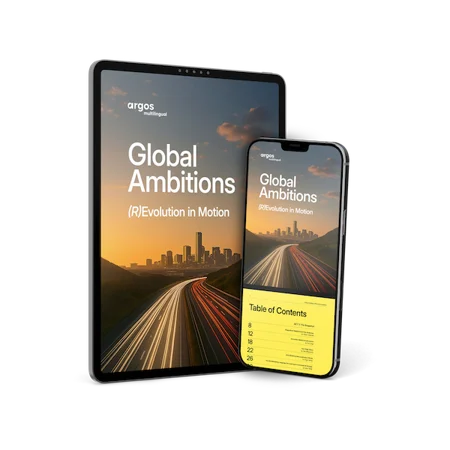
Read the full 132-page Global Ambitions: (R)Evolution in Motion publication featuring vital perspectives from 31 industry leaders on the ongoing AI-spurred (r)evolution.



-
The Content Newsroom: A Reimagining of Content Creation and Distribution
Unifying content creation and translation by putting creators and translators in the same room, creates a “content newsroom” for authentic, user-focused experiences.
-
On Talent and Those Who Get to Lead Us Into the Future
The localization industry faces a talent crisis driven by AI fears, declining diversity in leadership, and lack of clear future vision.
-
Reflections: From AI-Assisted to AI-Led Translation
AI agents enable translation to be AI-driven with human oversight, moving from AI-assisted work to AI-handled processes with quality control.