

Act 3: Reframing the Scene
What does the future hold?
Chances are, every person you ask this question will offer a different answer. And that’s as it should be (let’s leave the probable-words-in-a-sequence prediction to something else). The future will likely be composed of a multiplicity of parallel realities, much like a multi-colored glass vitrage.
Any discussion about the future comes with its share of responsibility. A responsibility toward ourselves, the teams we work in, and the communities we are involved in. A responsibility for those who come next — the next generation of talent that will be entering our industry.
When reading this closing section, ask yourselves: What are YOU doing to affect those around you positively?
Pedro Guerra Ribeiro
Head of Global Experience and Localization at Qualtrics

After a taxing 10-hour journey to my U.S. headquarters, tired and jetlagged, I instinctively did what localization professionals do best: absorb local culture one peculiar beverage at a time. On this occasion, I was nursing a “dirty Diet Coke” — a quintessential Utah concoction of soda laced with coconut syrup, fresh lime, and a splash of half-and-half.
The global marketing strategy meeting had been going on for over an hour, my jetlagged mind occasionally wandering to the dramatic mountain landscape visible through the conference room windows, when our CMO asked:
“How can we use AI to translate our campaigns faster?”
The dreaded question about AI translation pulled me back to full alertness. All eyes turned expectantly to me — the localization expert in the room — and in a moment of clarity, despite the travel fatigue and sugar rush, I felt the tipping point that is reshaping my career and our entire industry.
I quickly responded, “We are actively exploring several AI approaches that could benefit our campaigns.” Yes, my answer was riddled with corporate jargon and was adequately vague, yet I knew I had just committed myself to delivering tangible results. I started a timer.
This tipping point prompted me to confront profound questions about my professional future: What happens to traditional localization workflows as AI translation quality approaches human parity? What new value do we create when language barriers are increasingly dismantled by technology? And perhaps the most personal question of them all: How do we transform our own professional identities to lead in this new landscape?
The instinct for self-preservation is natural, but the opportunity before us is extraordinary. Much like that “dirty Diet Coke”: initially strange, unexpectedly refreshing, and composed of elements that shouldn‘t work together but somehow create something better than the sum of their parts. The fusion of localization expertise with AI, system design, and strategic business thinking might seem like an odd mixture, but it could be exactly the recipe our industry needs.
From doers to builders of systems
The months after that meeting have been marked by deep research, introspection, and a lot of getting my hands dirty. The first thing I realized is that from the traditional “buyer” perspective on localization, the classic localization manager’s role is no longer fit for purpose. In this efficiency-obsessed era, corporations crave holistic systems that free their top talent to focus on core business operations —manual task executors are quickly going out of fashion. This transformation mirrors what we‘ve seen in programming and software development, and our industry is now following suit. Clinging to outdated systems purely for self-preservation isn‘t just short-sighted — it‘s the express lane to professional irrelevance.
I realized that this evolution isn‘t just aspirational; it‘s existential. With AI platforms, AI agents, and streamlined workflow automation maturing at breakneck speed, companies can increasingly manage straightforward translation tasks without specialized localization staff (or so they think), and they will do it with or without you.
I came to see we are not only modernizing our tools and technology, but we are also modernizing our function from doers to builders of systems. A good localization manager excels at managing complexity, yet still finds themselves siloed, surrounded by stakeholders who “don‘t care” or “don‘t understand” their value.

The emerging localization orchestrator, however, transcends these limitations by standing at the nexus of business strategy and global operations. No longer are they merely contracting humans for manual tasks. They are now leveraging artificial intelligence and automation to do most of the manual work, so they can focus instead on governance, program design, stakeholder management, and strategic initiatives. These next-generation leaders are building systems that transform business objectives into hyper-localized, hyper-personalized global content while simultaneously analyzing data, proposing innovative solutions to stakeholders, and elevating their careers to unprecedented strategic heights within their organizations.
The frequent discussion of “human in the loop” workflows often carries defensive undertones — as if maintaining human involvement is primarily about preserving jobs. This framing misses a crucial point: Human strategic guidance in localization isn‘t about self-preservation; it‘s about self-actualization. Time to go from ideas to action!
Orchestrating the symphony of global content
So, here I am, armed with my self-motivation quotes on the walls, black coffee to keep me focused, and an unyielding determination to be my best self. I am on a Zoom call with my marketing department head, proposing a new scenario for the localization and global content architecture. A scenario where the system is built to maximize business value and keep our localization imperatives in the loop. This is the gist of it:
A regional marketing manager accesses our integrated content portal upon receiving a campaign brief. Using our fine-tuned LLM, they generate localized marketing materials — complete with appropriate style, terminology, and culturally-nuanced content. A single click routes the content through automated QA and to specialized linguists for review or rewriting (if necessary). The finished content returns directly to the regional marketing manager’s dashboard, ready for deployment. Meanwhile, our localization team monitors the system, manages exceptions, and continuously optimizes performance — transforming what was once a multi-step, time-consuming process into a seamless, self-service experience that maintains quality while dramatically reducing time-to-market.
When I am done illustrating to my colleague the architecture behind the system we need to build for our marketing engine, I finish my coffee fully aware that all of this is easier said than done. When the nod and words of approval and encouragement come from the other side of the monitor, I couldn’t be happier. There is a lot of work ahead to make this run smoothly like Usain Bolt, but it‘s a first step.
Let’s be honest, for a CMO, the proposal is exactly what they want for their function, but it‘s simultaneously a unique opportunity for me to transcend my role limitations.
By reimagining my role as system architect rather than word processor, I envision that we can finally deliver the immediacy my colleagues in marketing need. To become an invisible engine rather than the dreaded bottleneck we were once known as. Our marketers can get what they need when they need it, while my team and I focus on the far more stimulating work of ecosystem optimization and global strategy instead of chasing project deadlines.
This evolution doesn‘t mean we‘re working ourselves out of jobs — quite the opposite. We‘re elevating our role to something truly strategic and structurally essential. Just as the IT individual who once crawled under desks to connect cables now designs cloud architectures, we‘re branching from project managers into global program strategists. The localization function — once the department of “sorry, that‘ll take two weeks” — will become the enabler of global velocity.
The great extinction event?
Not exactly. Yes, the AI tipping point, with the growth of AI-generated content, solutions, and automations, is the catalyst for a rebranding and reimagining of my role. Yes, localization teams, already small in number, might become even smaller. But it also means one-person teams will be able to sustain complex and expanding localization programs, allowing more businesses to create these functions within their structure, enabling more content and services to go global.
I don’t see AI as an extinction-level event. It‘s more like a (hopefully brief) Ice Age, where adaptation, flexibility, and resilience will allow us to emerge as more complete and valuable professionals. Those who can’t adapt may remain locked in ice for eternity.
This isn‘t just the evolution of a role — I’m not afraid to call it the revolution of an industry. And for those willing to reimagine their purpose and develop new capabilities, the view beyond the next mountain isn‘t a threat, it‘s the most exciting opportunity our field has ever encountered.
So, I will leave you with a question, dear reader. As you reflect on your own role in the localization ecosystem, are you building systems that require your constant intervention, or are you creating infrastructure that empowers others while elevating your strategic contribution? The answer may determine not just your professional trajectory, but also the very future of localization itself.
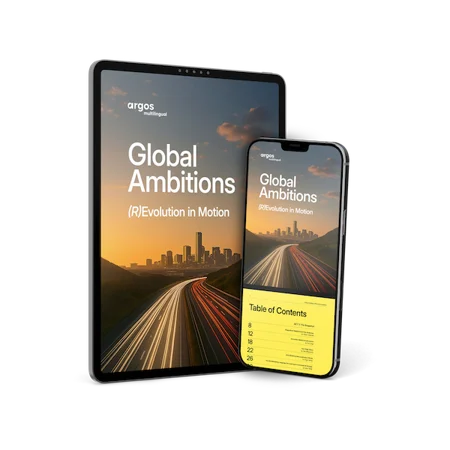
Read the full 132-page Global Ambitions: (R)Evolution in Motion publication featuring vital perspectives from 31 industry leaders on the ongoing AI-spurred (r)evolution.
-
Choosing the Right Timeline
Localization must shift from reactive adaptation to strategic orchestration, integrating tools and workflows to transform content delivery.
-
The Breakthroughs Are Real — And They’re Finally Enterprise-Ready
AI in localization is moving from demos to real-world enterprise solutions, with integrated tools that automate workflows while maintaining quality and control.
-
The Quality Question: What Happens Before and After the Prompt?
Generative AI scales content fast, but quality must be designed upfront through intent modeling and validated via frameworks like MMQEval.