

Act 2: Moving Pictures
It’s been three years with GenAI in our lives.
You may think we understand what AI can or cannot do (at least those in the Global North think they do). But think again. There are entire regions of the world that are playing catch-up to the AI-first reality. And there are always newcomers to our industry who need guidance to set them on the right path.
Ultimately, progress will look different to every team and professional. It won’t be linear, and it may come at a cost. It may require us to redefine ourselves. In our quest onward, no one should be left behind, right?
In this section, read the articles that explore the human side of the (r)evolution unfolding around us.
Mario Pluzny
Career Clarity and Life Coach

Not a conference or water cooler discussion goes by without the word AI dominating the discourse. While innovation brings many positives, it also has a darker side that is negatively impacting our mental well-being.
As a qualified Career and Life Coach working with clients almost exclusively from our industry, I’ve seen firsthand the many challenges that localization professionals face today.
We’re all just seeking answers, trying to do better and be better. The good news is, there is always a way (and yes, it can get hairy before it gets better). But before we find solutions, we should name things.
Here is what I propose.
The state of the human in the loop
Put simply, we‘re overwhelmed.
In my coaching practice, the first step to getting better is recognizing and naming the problem. So before we shift the power, let’s unpack some observations that may ring true for you, too:
- I hear many of my clients complain about cognitive overload. The sheer amount of information is overwhelming, and it feels increasingly difficult to sit down and focus on just one task. This feeling of being overwhelmed influences many of our reactions and actions, for better or worse.
- The C-level is not making lives easier: Leadership wants (and perhaps needs?) to jump on the AI bandwagon. Rather than exploring slowly or running small experiments, they want things yesterday. To compound matters, we often deal with teams and leaders who are unfamiliar with localization. Educating our stakeholders and leadership teams on both the localization process and how AI can (or cannot) fit into it feels doubly exhausting.
- As a (gut) reaction to our world spinning too fast, I see many people going on sick leave, quitting their jobs, or leaving the industry altogether. This is because we‘re unable to keep up, regulate, and organize our time in order to mitigate the external pressures. AI feels like that one extra thing we could have done without in an already overwhelming world. Our fight-or-flight response is kicking in, leading to career- and life-altering decisions.
- I call this sense of disillusionment with how things are an identity crisis. AI is now adding an existential component to the spectrum of emotions that feels unwanted and is unsolvable for many. Many people I speak to regularly are translators or come from a linguistic background. Everything they do or have worked towards is now being questioned and shaken to the core. What once took hours of research and a human thinking and puzzling over, can now be done with a tool quickly, despite not being at the same quality level (yet). One question arises repeatedly: “Where do I look for motivation?”
There are positives, too, of course. For one, talking about mental health is not necessarily taboo anymore. Some companies are also offering mental health benefits, such as the option to take leave (although this may not be sufficiently widespread yet, and freelancers cannot typically access it).
One thing that often goes amiss — and I try to help my clients rediscover it — is that going through adversity builds resilience. The trick is in giving yourselves the keys to creating it.

Shifting the power
In the coaching process, I help my clients sit with the problem they’re experiencing, examine it from all angles, and push them to proactively tackle it with action. I shift the power back onto them.
When someone is first seeking support in the form of therapy, coaching, or mentoring, they may believe that the person they’re speaking to will solve their problems for them. However, we are the architects of our own lives, and positive change starts with accountability.
As a coach, I provide a mirror to my clients and ask them questions such as, “What do you want to do?” or “What can you do about this situation?” or “Where do you want to take this?” This is because, in our gut, we usually know what we need to do, and often the first solution that comes to us is the right one. The coach is there to provide that initial nudge to make space for reflection and identifying solutions. The coach might just accelerate this process and provide an external perspective to get started.
We may be a generation of overthinkers — we almost feel compelled to ruminate or consider things from different angles. And that’s precisely it. Our gut knows what to do. You just need to reconnect with it. Want to get unstuck? One little trick if you‘re sitting with a problem is that a shift in your physical environment can provide a different stimulus that will help.
Action = Accountability
As we consult AI for almost everything these days, I can’t help but think about the idea of “prompting.” In the same way that a successful response in ChatGPT depends on the quality of your prompt, coaching works similarly.
So, what makes a good coaching prompt? It’s usually a question that makes people think… and then take action.
As a coach, I ask open-ended questions because that is what makes people reflect and think. This can start with a very broad introductory question that we then narrow down. For example, we may start with “What‘s on your mind?” and then I funnel the conversation into something more specific or dig deeper with “And what else?” or “How does this affect you/your life right now?”
At the end of each coaching session, I want clients to recognize how far they‘ve come and understand that they have control over their responses to situations. We need to learn to hold ourselves accountable. This is because the best plan is good on paper, but it goes nowhere without real, tangible action.
In those spaces shared between a coach and client, or when you sit alone at home with nothing but your thoughts for company, the clear shift that needs to happen is for you to regain power. The theme is clear: There‘s always something you can do.
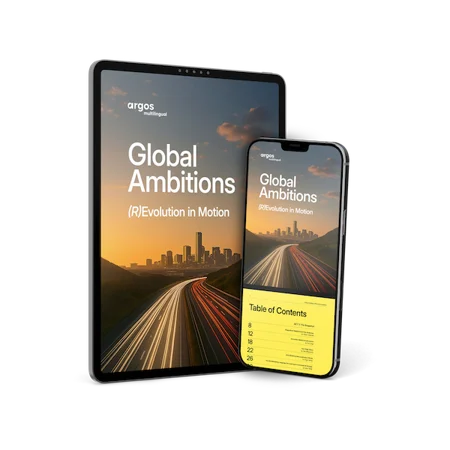
Read the full 132-page Global Ambitions: (R)Evolution in Motion publication featuring vital perspectives from 31 industry leaders on the ongoing AI-spurred (r)evolution.
-
AI Is Widening the Localization Divide
AI is widening the gap in localization—teams with clear strategies and tools are scaling fast, while others remain stuck in reactive, manual workflows.
-
Progress Comes from Within
Africa is building its own AI solutions despite infrastructure challenges, focusing on mobile-first, low-code tools that work locally rather than waiting for external investment.
-
Our Origin Story
The localization industry’s past decade of incremental progress—APIs, orchestration, and MT adoption—quietly laid the groundwork for today’s AI-driven transformation.