


Act 1: The Snapshot
We begin with our feet firmly planted in the present and reflect on where the language services industry currently stands (spoiler: there’s no way to avoid this thing called GenAI).
But do we understand where we are and where we are headed? Are we asking the right questions, or should we just start with the “Why”?
There is a sense of urgency that powers the varied market players. We explore new pathways, test new solutions, learn from the mistakes made along the way, course-correct, and start again.
The industry is evolving, and we are in motion. In the following pages, we examine what this movement looks like.
Simone Bohnenberger-Rich, PhD
Chief Product Officer at Phrase

Localization is undergoing a necessary reckoning. Long-standing practices, such as treating fuzzy matches as quality proxies or relying on static style guides, are increasingly unfit for the complexities of global, multi-channel content. The industry must evolve from rigid reuse of past translations toward intelligent, real-time orchestration. AI systems need to interpret context, tone, and intent from the start to guide how content is adapted across channels.
What’s driving this shift? GenAI/LLMs have redefined what’s possible. Their strength lies not in matching words, but in capturing nuance using tone, intent, persona, and other key considerations and insights. But this nuance cannot be summoned from fuzzy matches. Unless a match is “perfect,” it often fails to provide the kind of rich context these systems need.
Instead, a new class of inputs is emerging. Style guides, glossaries, and TMs are being leveraged in dynamic, machine-readable content profiles. These are bundles of structured context (e.g., tone, audience, platform constraints) that guide generation from the outset. This isn’t about polishing output after the fact; it’s about shaping intent at the source.
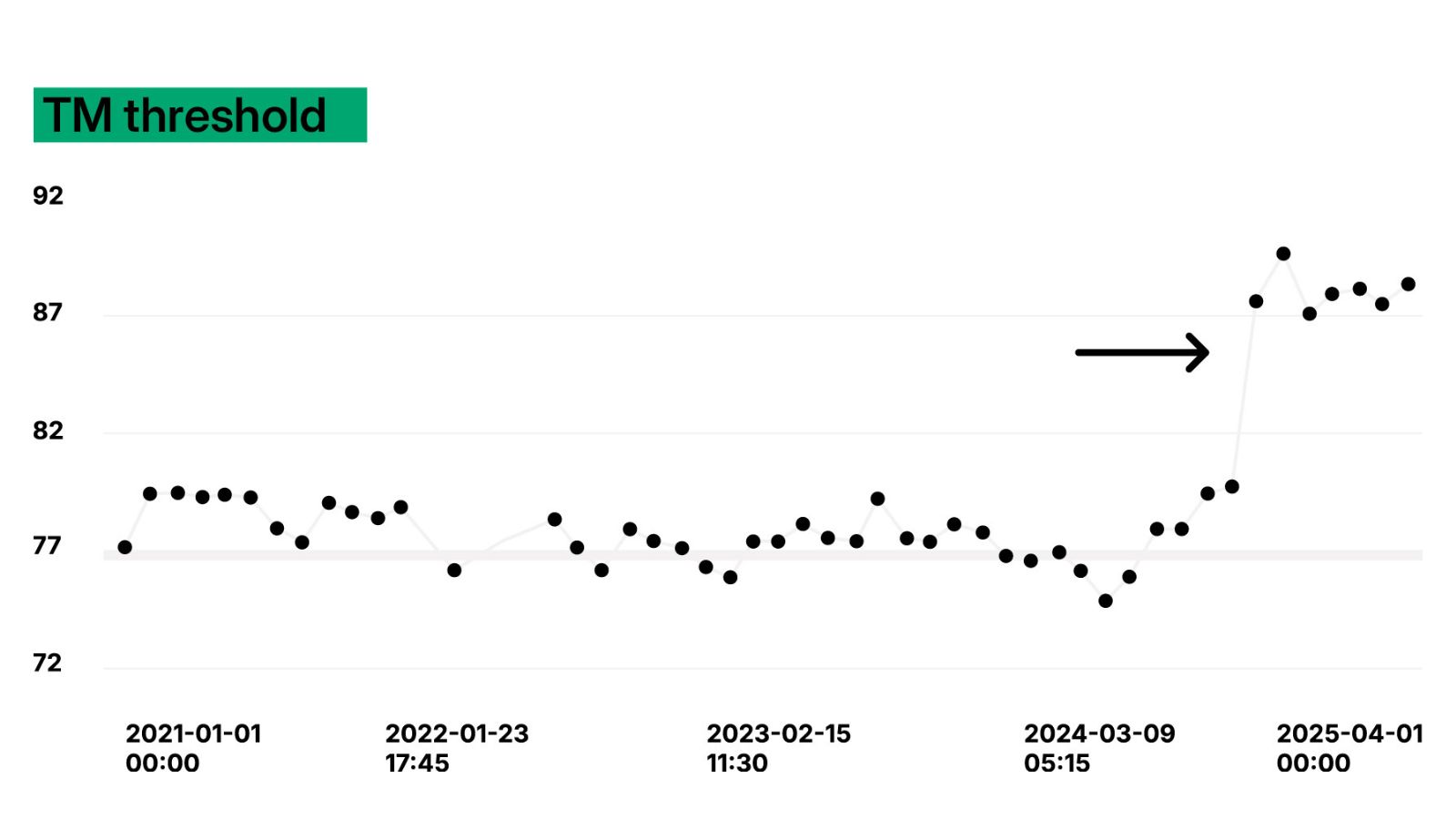
Our data (see graph) highlights this shift. Over a two-month period earlier this year, platform usage analysis reveals that fuzzy match thresholds tightened significantly. The average increased from 70% to 86%. This indicates a clear move towards AI-led “straight-through” processing. This marks a significant shift in behavior, given that these TM thresholds had been largely flat in the previous years. The confidence to bypass fuzzy matches here signals rising trust in AI‘s ability to fill contextual gaps where TMs just fall short.
This evolution is not just about improving outputs; it lays the groundwork for Agentic AI in localization. These systems aim to automate entire workflows, making decisions on model selection, quality checks, and exception handling without human intervention. That autonomy demands structured, machine-readable context. Without clear inputs (tone, audience, risk constraints), agents cannot reason effectively. In this emerging paradigm, TMs, style guides, and glossaries must become dynamic signals, not static references.
The future of localization isn’t reactive. It’s intelligent, intent-driven, and designed
for scale.
Read the full 132-page Global Ambitions: (R)Evolution in Motion publication featuring vital perspectives from 31 industry leaders on the ongoing AI-spurred (r)evolution.
-
The Quality Question: What Happens Before and After the Prompt?
Generative AI scales content fast, but quality must be designed upfront through intent modeling and validated via frameworks like MMQEval.
-
Rewriting the Script: Localization in the Age of AI
Localization isn’t dying—it’s evolving from task-based work to strategic discipline, requiring us to focus on business impact over word counts.
-
Two Visions of What Awaits Beyond the Next Hill
AI transforms the language industry, creating demand for premium human-curated content and positioning language professionals as essential AI educators.