

Act 2: Moving Pictures
It’s been three years with GenAI in our lives.
You may think we understand what AI can or cannot do (at least those in the Global North think they do). But think again. There are entire regions of the world that are playing catch-up to the AI-first reality. And there are always newcomers to our industry who need guidance to set them on the right path.
Ultimately, progress will look different to every team and professional. It won’t be linear, and it may come at a cost. It may require us to redefine ourselves. In our quest onward, no one should be left behind, right?
In this section, read the articles that explore the human side of the (r)evolution unfolding around us.
Mathijs Sonnemans
Vice President of Product at Blackbird

In every great story, there comes a moment where the universe splits – not into good and evil – but into possibility. The localization industry stands at such a crossroads today. For years, we’ve reacted to new content demands, shifting technologies, and rising customer expectations. But now, the multiverse is open. Multiple paths stretch before us. Some lead to operational chaos, others to strategic clarity.
The question is no longer can we adapt? It’s: Which timeline will we choose?
Much like Doctor Strange confronting countless futures, localization teams must stop reacting to change and instead orchestrate it. This moment isn’t about surviving content demands. It’s about mastering them. When machine translation emerged, the industry scrambled to integrate it. This often happened in isolated pilots rather than holistic workflows. As AI quality improved, the debates raged:
Is it better than humans? Is it ready for prime time?
But in focusing solely on whether AI could replace existing processes, we missed the bigger opportunity. Because the real question wasn’t about quality comparisons. It was about redefining how we localize and the business models that underpin it.
Today, the shift to strategic thinking is underway. Localization leaders are no longer content to react; they’re looking at their tech stacks and asking:
How do these tools align with our business goals?
This is where orchestration platforms and middleware step in as the connective tissue. Like Nick Fury bringing together diverse heroes into one coordinated force, orchestration tools unify fragmented systems:
Connecting content management, TMS, MT, and publishing workflows
Enabling integrated and continuous localization (where content flows seamlessly from creation to global delivery)
Supporting quality-based and analytics-based routing, so decisions are data-driven rather than guesswork
The rise of these tools represents a fundamental mindset change: from How do we translate faster? to How do we create, manage, and deliver global content smarter?
However, technology alone isn’t enough. Just as Tony Stark’s suit is useless without the person inside, orchestration tools require organizations to rethink how they work:
- Pricing models are under pressure as customers expect more for less. Traditional per-word billing struggles to capture the value of integrated, multimodal content repurposing.
- Services are shifting from transactional projects to embedded, strategic partnerships.
- Customer expectations now include speed, scalability, and visibility, not just quality.
Proactive transformation starts with orchestration. By integrating disparate systems, enabling multimodal content repurposing, and shifting localization left into the creation process, teams gain superpowers:
- Faster time-to-market for multilingual content.
- Reduced manual workflows and operational waste.
- Strategic insights through data and analytics.
In the Marvel universe, the multiverse isn’t just a metaphor. It’s a challenge. A test of vision, judgment, and timing. For localization, this is our multiversal moment. We can remain stuck in fragmented processes and reactive habits, or we can choose a new timeline – one defined by orchestration, integration, and strategic impact.
Because progress is inevitable, but direction is a choice. The winning timeline is the one where localization becomes not just a service, but a superpower.
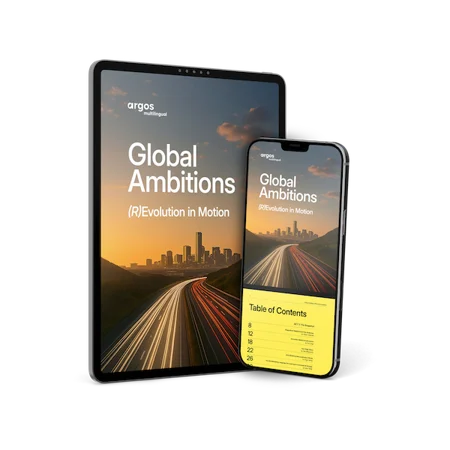
Read the full 132-page Global Ambitions: (R)Evolution in Motion publication featuring vital perspectives from 31 industry leaders on the ongoing AI-spurred (r)evolution.



-
Why Localization Is Now a Product Problem
Localization has evolved from a specialty service into a core product feature that directly impacts user trust, retention, and global market success.
-
The Quality Question: What Happens Before and After the Prompt?
Generative AI scales content fast, but quality must be designed upfront through intent modeling and validated via frameworks like MMQEval.
-
We Are the Masters of Our Destiny… Or Are We?
The localization industry faces uncertainty from AI, but opportunities exist through knowledge, agility, community, and authentic collaboration.